
Cost to wire a new house in Ontario (2026 guide).
What does it actually cost to wire a new custom home in Ontario in 2026? Here's the honest answer — broken down by square footage, by stage, and by add-on — from a licensed electrical contractor working Eastern Ontario new builds every week.
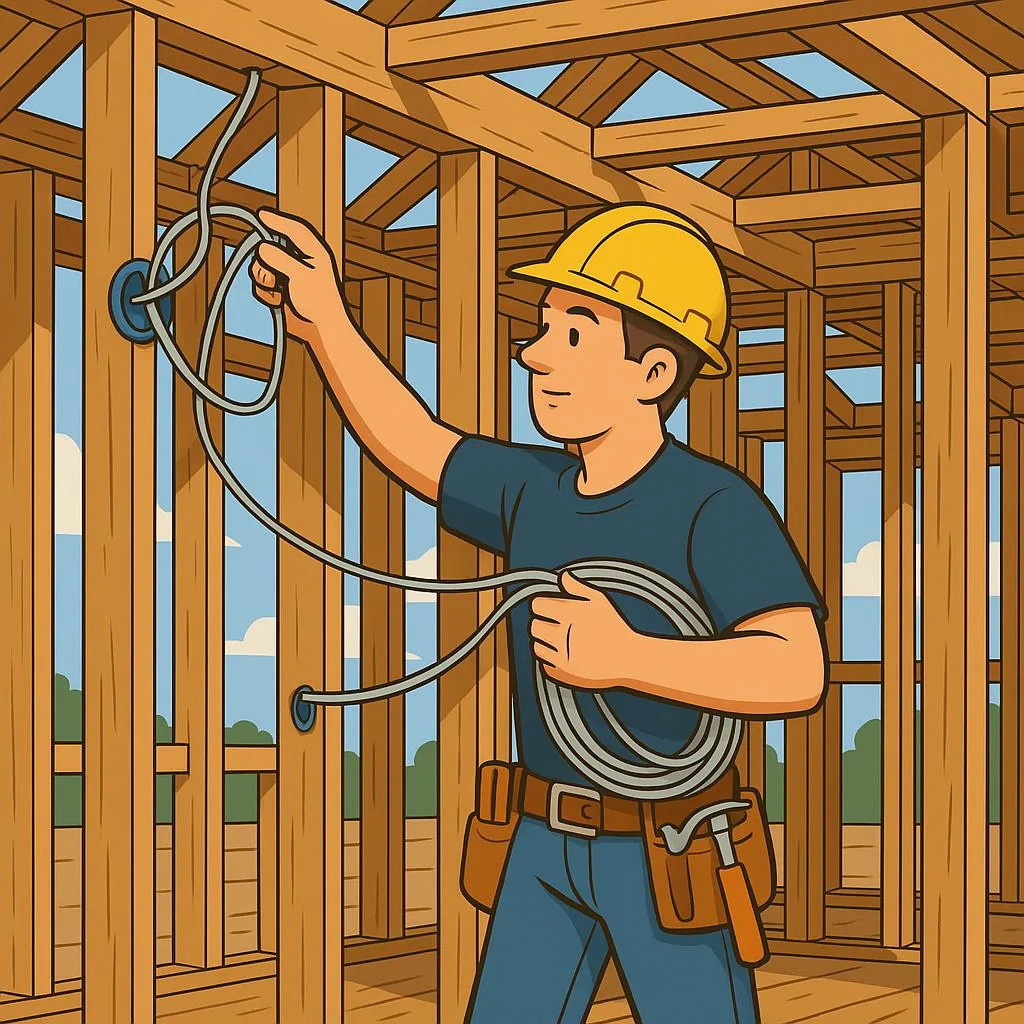
Most new custom homes in Ontario cost $14,000 to $28,000 for a complete electrical package in 2026 — materials, labour, permits, and all three ESA inspections included. A typical 2,000 sq ft two-storey with a 200A underground service, standard finishes, and a couple of common add-ons (EV circuit, A/C) lands around $20,000–$24,000. Square footage, service type, floor count, and add-on list drive most of the variance.
What this guide covers
- Price ranges by house size
- Six things that actually drive the price
- Cost by stage: underground, rough-in, finish
- What a complete package includes
- Add-ons and pre-wire upgrades worth the money
- What's usually not included
- Regional factors across Ontario
- How to get an accurate number for your build
- Frequently asked questions
Price ranges by house size
Ballpark 2026 pricing for a new single-family build in Ontario with 200A underground service, standard finishes, and typical device counts. Add-ons and site conditions shift these numbers in either direction.
| House Size | Typical Layout | Expected Range | Most Common |
|---|---|---|---|
| 1,000–1,400 sq ft | Small bungalow, 2–3 bed | $12,000–$17,000 | ~$14,500 |
| 1,500–1,900 sq ft | Mid-size bungalow or small 2-storey | $15,000–$21,000 | ~$18,000 |
| 2,000–2,500 sq ft | Typical custom 2-storey, 3–4 bed | $18,000–$24,000 | ~$21,000 |
| 2,600–3,200 sq ft | Large 2-storey with basement | $22,000–$28,000 | ~$25,000 |
| 3,300–4,500 sq ft | Executive custom, 4+ bed | $27,000–$38,000 | ~$32,000 |
| 4,500+ sq ft | Luxury custom with finished basement | $35,000+ | Quote only |
These ranges assume a 200A underground service, conventional stud framing, forced-air heating, and standard 15A/20A branch circuits. Electric heat, ICF construction, finished basements, triple garages, outbuildings, and pools all add above the base range. For a real number on your specific build, use the free estimate tool — it takes about 90 seconds.
Six things that actually drive the price
Every new-home electrical quote is the sum of these six variables. Understanding them is how you compare quotes apples to apples.
1. Square footage
Drives device count (outlets, switches, lighting) and the length of wire needed for branch circuits. A 3,000 sq ft house doesn't cost 50% more than a 2,000 sq ft house for electrical — but it's usually 20–25% more because of the additional device count and runs.
2. Service size & type
200A is the modern default; 100A is still permitted for smaller homes without EV or electric heat but limits you long-term. Underground service costs more than overhead because of trenching, conduit, and the buried-depth inspection — usually $800–$1,500 more for a residential run.
3. Number of floors
A two-storey costs 10–15% more than a bungalow of the same square footage. Three-storey or split-level homes add more. The math: every run between floors takes more cable, more fishing time, and more careful coordination with the framers.
4. Heating & cooling
Forced-air gas is lightest on electrical. Electric baseboard heat adds a dedicated circuit to nearly every room — easily $2,000–$3,500 extra. Heat pumps, central A/C, and electric furnaces add a large dedicated circuit each. Radiant floor heating adds a thermostat circuit per zone.
5. Add-on circuits
EV charger, hot tub, pool, generator inlet, sauna, heated garage, workshop, outbuilding, exterior lighting. Each is a dedicated circuit or sub-panel feed. Most run $500–$1,500 each at rough-in; retrofitting after drywall easily doubles that.
6. Finish level & fixtures
Smart switches, dimmers on every circuit, under-cabinet LED, dedicated ceiling fan rough-ins, structured cable (Cat6/coax), home office 20A circuits, exterior outlet count. Baseline finish vs. executive finish can be a $2,000–$5,000 spread on the same floorplan.
Cost by stage: where the money actually goes
A new-home electrical quote isn't one lump sum — it's three separate visits with three invoices. Here's how the budget typically splits on a $20,000 build.
Stage 1 — Underground
~10–15%
($2,000–$3,000)
Meter base, service conduit, underground wire from the transformer or pole to the panel location. Buried at code depth during foundation backfill. ESA underground inspection included. Skipped entirely if the service is overhead.
Stage 2 — Rough-in
~55–65%
($11,000–$13,000)
Panel set, all branch circuits pulled, every box and nail plate installed, smoke/CO locations verified, kitchen and appliance circuits run. This is the biggest stage by far — it's where every wire in the house gets installed, and where ESA signs off before insulation closes the walls.
Stage 3 — Finish
~25–30%
($5,000–$6,000)
Devices installed (outlets, switches, dimmers), panel trimmed and labelled, fixtures wired (when the homeowner supplies them), smoke/CO detectors activated, final ESA inspection. Ends with a Certificate of Acceptance — you need this for your occupancy permit.
Invoicing follows the stages. Most builders pay after each ESA milestone so there's a clear pass-fail gate before money moves. This also means if your build stalls between rough-in and finish, your electrical bill stops at rough-in — you don't owe for work that hasn't happened.
What a complete package actually includes
A fair comparison between quotes starts here. If one quote is $4,000 lower, it's usually because these items are missing — not because the electrician is cheaper.
Materials & installation
- Service entrance and meter base
- Main panel and every breaker (including AFCI where code requires)
- All branch circuit wiring (14/2, 12/2, 14/3 as required)
- Stove feed (8/3) and dryer feed (10/3)
- Kitchen circuits (minimum two 20A small-appliance, dishwasher, microwave, fridge)
- Bathroom GFCI circuits and exhaust fan wiring
- All outlets, switches, and device plates
- Interconnected hardwired smoke & CO detectors with battery backup
- HRV / air exchanger circuit
- Furnace and A/C circuits (wiring only, not equipment)
- Exterior receptacles and basic exterior lighting rough-in
- Panel directory filled out, breakers labelled
Permits, inspections & labour
- ESA (Electrical Safety Authority) permit — typically $400–$600 for a residential new build
- Underground inspection (if applicable)
- Rough-in inspection before insulation
- Final inspection after finish stage
- Certificate of Acceptance issued by ESA
- Three mobilizations to site (or two if overhead service)
- Walkthrough with homeowner and/or GC at handover
- Written warranty on workmanship (1 year is the industry standard)
- $2M liability insurance coverage in place
- WSIB coverage for all on-site workers
Add-ons worth the money at rough-in
Anything you might want in the next 10 years is cheaper to pre-wire now than to retrofit later. Here's what actually pays off.
| Add-on | Cost at Rough-in | Cost as Retrofit | Savings |
|---|---|---|---|
| EV charger circuit (40A–50A to garage) | $750–$1,200 | $2,000–$2,800 | ~$1,500 |
| Central A/C circuit | $300–$600 | $900–$1,400 | ~$700 |
| Hot tub pre-wire (50A GFCI) | $750–$1,100 | $1,800–$2,500 | ~$1,200 |
| Heated floor circuits (per zone) | $400–$700 | Usually impossible post-finish | Huge |
| Generator inlet (manual transfer) | $700–$1,200 | $1,500–$2,500 | ~$900 |
| Whole-home surge protector | $250–$400 | $350–$500 | Modest — but do it |
| Outbuilding / garage sub-panel | $1,500–$3,500 | $3,000–$6,000 | ~$2,000 |
| Home office 20A dedicated | $150–$300 | $400–$700 | ~$300 |
| Ceiling fan rough-in (per bedroom) | $50–$120 | $250–$450 | ~$250 |
The honest rule: if you think there's even a 30% chance you'll want something in the next decade, pre-wire it. Opening walls after the fact is where renovation budgets go to die.
Regional factors across Ontario
Pricing varies regionally — here's how it tends to break down in 2026.
Eastern Ontario (Ottawa, Cornwall, Kemptville, Morrisburg)
Most residential rates land $90–$110/hour for licensed journeyman labour, with rural builds carrying slightly higher mobilization costs for travel. Hydro One is the primary utility outside the City of Ottawa; Hydro Ottawa serves the urban core. ESA inspection wait times are typically 2–5 business days and are rarely a bottleneck.
Greater Toronto Area
Rates are higher — $110–$145/hour is common — driven by operating costs, congestion, and the density of large-scale residential work. Expect total wiring costs to run 15–25% above Eastern Ontario for an equivalent home.
Southwestern Ontario (Hamilton, Kitchener-Waterloo, London)
Rates sit between Eastern Ontario and the GTA — usually $95–$125/hour. Alectra, Hydro One, and local utilities (Hamilton Utilities, Waterloo North Hydro) operate in different pockets, and coordination requirements vary.
Northern Ontario
Lower base labour rates but materials and delivery cost more, and long-distance mobilization can be a meaningful line item. Remote sites may also require generator power during rough-in if the service isn't energized until late in the build.
Cornerstone Electrical works across Eastern Ontario — Ottawa, Cornwall, Morrisburg, Winchester, Kemptville, Brockville, Casselman, Embrun, Russell, Chesterville, Stittsville, Kanata, Nepean, Orléans, Rockland, and Manotick.
How to get an accurate number for your build
Ballparks are useful for budgeting. Locking the number in takes a bit more information.
Use the free estimate tool
Our instant estimate tool takes about 90 seconds and uses your actual inputs — square footage, service size, number of floors, bedrooms, add-ons — to produce a realistic number you can budget against. It's built on the same pricing we use for real quotes.
Share the plan set for a locked quote
Once you have blueprints or a floor plan, we can walk through the site (or the plans remotely), confirm the scope, and issue an itemized quote that locks the price. We cover every stage, every add-on, and every line item — no surprise charges at finish.
Ask for the inclusions list in writing
The single best thing you can do when comparing electrical quotes is to ask each contractor for a written scope list. What's in, what's out, what the ESA permit covers, what happens if the schedule slips. A $2,000 spread between two quotes almost always comes down to something that was or wasn't on the list.
Check licensing & insurance before you sign
In Ontario, residential electrical work requires a 309A (Construction and Maintenance Electrician) license and ECRA/ESA registration for the contracting business. Ask for the ECRA number and check it on the ESA website — it takes 30 seconds and confirms the quote is coming from a real, registered contractor.
Get a realistic number for your specific build in 90 seconds
Answer a few questions about your square footage, service, and add-ons. Our free estimate tool uses real 2026 pricing from recent Eastern Ontario new builds.
Open the Free Estimate ToolFrequently asked questions
For a typical 2,000 sq ft single-family home in Eastern Ontario with a 200A underground service and standard finishes, a complete electrical package usually lands between $18,000 and $24,000 including materials, labour, ESA permit, and all three inspections. Add-ons like EV chargers, heated floors, hot tub pre-wire, or A/C circuits add about $750 each. The total is split across three visits: underground, rough-in, and finish.
A complete residential wiring package includes service entrance and meter base, main panel and all breakers, every branch circuit in the house (outlets, switches, lighting, appliance circuits), interconnected hardwired smoke and CO detectors, the ESA permit, and all required inspections (underground, rough-in, and final). It does not include light fixtures, ceiling fans, smart switches, low-voltage data/coax, or anything the homeowner is supplying.
A single-storey bungalow of the same square footage is usually 10–15% cheaper to wire than a two-storey because all the rough-in happens on one level, no chases or mid-floor runs are required, and drilling/fishing is faster. Two-storey homes pay a floor multiplier for the extra labour time and wire length between levels.
Roughing in an EV charger circuit (40A or 50A breaker, dedicated conduit and cable to the garage) during new construction typically adds $750–$1,200 depending on the distance from the panel and the charger amperage. The same install as a retrofit after drywall often runs $2,000–$2,800, so pre-wiring during rough-in is a clear win if there's any chance you'll own an EV in the next decade.
For a new-build single-family home in Ontario, 200A is effectively the modern default. A 100A service is technically permitted for smaller homes without electric heat, A/C, EV charger, or electric range — but the moment you want any two of those, you're constrained. The cost difference between a 200A and 100A install is usually a few hundred dollars, which is almost always worth it for the future-proofing.
Rough-in is where every circuit in the house gets pulled, the panel is set and populated, and every box, nail plate, and cable clip gets installed — typically 60–70% of the total labour and most of the material spend. Finish stage is faster because everything is pre-placed; the electrician is mostly making up devices and installing cover plates. Rough-in is also the milestone that has to hit schedule, since insulation and drywall are waiting on ESA to sign off.
The biggest drivers are service size (100A vs 200A), service type (underground costs more than overhead because of trenching and conduit), square footage and number of floors (drives device count and labour), heating type (electric baseboard adds significant circuit count), and the add-on list (EV, A/C, hot tub, heated floors, generator inlet, extra outlets, smart wiring). A quote that's unusually cheap usually excludes the ESA permit, assumes overhead service, or undercounts devices — compare scope line by line, not just totals.
Three site visits spread over the build schedule. Underground is typically a half-day during foundation backfill. Rough-in is 3–5 days on a typical 2,000–2,500 sq ft home, scheduled after framing is complete and windows are in. Finish is 2–3 days at the end, after paint and flooring. Calendar time is usually 4–8 months end-to-end because most of it is waiting for other trades.
The electrician is required to be on site for each inspection, but the homeowner does not need to be there. We schedule, attend, and handle any findings with the inspector. Once the final inspection passes, the Certificate of Acceptance is issued by ESA and handed to you — you'll need it for your occupancy permit.
What our customers are saying
Real reviews from real customers on Google.
“I had an excellent experience with Cornerstone Electrical installing the charger for my Ford Mustang Mach-E. The installation was done professionally, everything was neat and well organized, and the entire process was smooth from start to finish. The electrician was incredibly friendly, knowledgeable, and took the time to answer all of my questions. It’s clear they take pride in their work. I highly recommend Cornerstone Electrical to anyone looking for a reliable EV charger installation. Five stars all the way!”
“Great service and communication. I emailed them for a quote. I got a quick response back. I needed a EV charger installed and some breaker change in my panels. The job was quick and everything looks good and professional. I would definitely recommend them.”
“Excellent service / top-notch job completion. Was on time and completed the necessary work in a professional manner. Was very polite and great to work with. Would absolutely recommend.”
Ready to get a locked number for your build?
Share your plan set or a rough scope and we'll come back with a full itemized electrical quote, a schedule for all three stages, and a list of pre-wire options worth considering.
Request a Quote